Master Your Week: Unlocking the Power of Canva Editable Weekly Planner Templates
There is a specific kind of creative friction that happens when you know you need to organize your schedule, but the thought of starting a layout from scratch in a design tool feels exhausting. I see this constantly with clients and fellow creators. We treat planning as a chore, yet we demand our tools be aesthetically pleasing. The solution isn't choosing between a beautiful design and a functional system; it is finding a tool that respects both. That is exactly where the utility of Canva Editable Weekly Planner Templates shines. These aren't just digital pieces of paper; they are sophisticated design assets that bridge the gap between strict graphic design principles and the chaotic reality of a busy life.
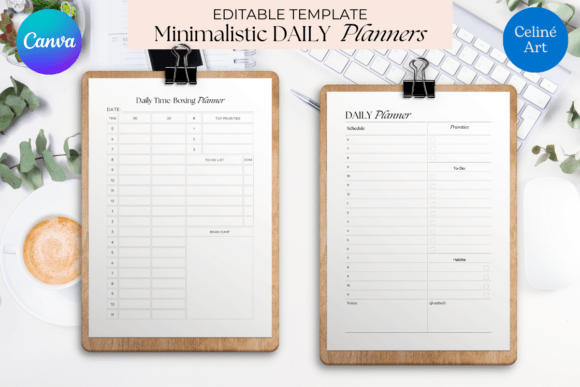
The real value here lies in the versatility of the system. You aren't locked into a single aesthetic. You are given a framework that includes four distinct designs, ranging from minimalist structures to more expressive layouts. This variety is crucial for brand identity work. If you are a small business owner or a content creator, your weekly content calendar needs to look like it belongs to your brand, not a generic third-party app. These templates allow for deep customization of colors, fonts, and other design elements, meaning the final product feels bespoke. Whether you are scheduling Instagram posts, blocking out client work, or organizing family meals, the visual consistency remains professional.
The Anatomy of a Professional Layout
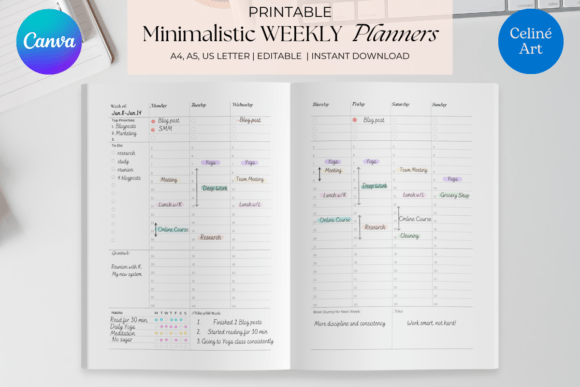
When we talk about the visual characteristics of these Canva Editable Weekly Planner Templates, we aren't just looking at pretty boxes on a grid. We are looking at information hierarchy. A well-designed planner uses negative space to guide the eye, ensuring that the most critical tasks don't get lost in the noise. The personality of these templates leans toward the modern typography movement—clean lines, balanced margins, and intentional whitespace. They possess an elegant appeal that feels elevated compared to standard office templates. This is vital for designers and marketers who view their planning tools as an extension of their creative process.
The style is adaptable, which is the hallmark of a premium font and layout system. You might encounter layouts that utilize sans serif font families for a sleek, corporate feel, perfect for a digital marketing agency. Alternatively, other variations might incorporate softer typography suited for lifestyle blogs or creative studios. The "personality" of the planner changes entirely based on your input. By swapping the default typeface for your specific brand identity typeface—be it a bold display font for headers or a highly readable serif for body text—you transform a generic template into a cohesive part of your editorial design ecosystem.
Real-World Application: From Screen to Print
One of the most practical aspects of this collection is the dimensional flexibility. We often struggle with the translation between web design needs and physical prints. These templates solve that by offering three optimized sizes: Letter Size (8.5’’ x 11’’), A4 (8.3’’ x 11.7’’), and A5 (5.8’’ x 8.3’’). This covers nearly every standard requirement for both American and international paper sizes.
Let’s look at how this impacts different sectors:
- For the Entrepreneur and Marketer: The A4 size is often the standard for client-facing reports or internal strategy documents. Using a customized template here ensures that even your internal logistics look polished. It reinforces professionalism before a single word of the content is read.
- For the Hobbyist and Crafter: The A5 size is the "Goldilocks" zone for personal journals, bullet journals, or Etsy shop planning. It is compact enough to sit on a desk without dominating the workspace but large enough to accommodate handwriting or detailed notes.
- For Social Media Managers: The Letter size is excellent for printing out weekly content calendars to pin to a corkboard. There is a tactile benefit to seeing your week physically laid out, even if the execution happens digitally.
The ability to mix and match these four designs across different sizes means you aren't recycling the same look every week. You can use a bold, high-contrast design for your Monday "kick-off" planning and a softer, more relaxed layout for your weekend review. This keeps the planning process fresh, which is a psychological trick to ensure you actually stick to your organizational goals.
Strategic Design: Typography and Visual Hierarchy
As a creative professional, I cannot overstate the importance of readability and visual hierarchy in planning tools. A cluttered planner creates mental clutter. The strength of these Canva Editable Weekly Planner Templates is that the hard work of typesetting has already been done for you. The grids are aligned, the gutters are measured, and the text blocks are sized for legibility.
However, the real magic happens when you intervene with font pairing. If you are customizing these for a boutique hotel or a high-end fashion brand, you might introduce a serif font or a sophisticated script font for the headers. If you are a tech startup, you might stick to a geometric sans serif font to communicate efficiency and modernity. The templates act as a canvas for your creative font choices.
Consider the impact on your team or your personal workflow. When a document looks professional, you treat the content within it with more gravity. Using these templates for packaging design timelines or logo design project phases ensures that every stakeholder takes the deadlines seriously. It is a subtle form of psychological priming. The consistent use of specific typography styles across your planners, invoices, and social media graphics builds a recognizable typeface language for your brand.
Practical Guidance for Customization
To get the most out of these design assets, you need to approach the customization process with a strategy. Here is how I recommend utilizing these templates effectively:
- Evaluate the Grid: Before you change the colors, look at the structure. Does the layout support your specific needs? If you are a blogger, you might need larger text blocks for "Content Ideas." If you are a crafter, you might need checkbox areas for supply lists. Choose the design that best fits the function first.
- Brand Consistency: Upload your brand kit to Canva immediately. Do not rely on the default colors. Swap the hex codes to match your primary and secondary brand palette. This turns the planner into a piece of marketing collateral, even if it’s just for your eyes.
- Typography Testing: When swapping fonts, check the readability at different scales. A handwritten font might look charming for the title "Weekly Goals," but it will be illegible for small time slots like "9:00 AM." Use display fonts sparingly for headers and stick to clean, legible typefaces for the data points.
- Licensing Awareness: Because these are designed for Canva, you have the freedom to use them for commercial and personal projects. You can create a planner, save it as a PDF, and even sell that PDF to your own audience (provided you adhere to Canva’s specific licensing terms regarding redistribution of templates). This creates a potential revenue stream for publishers and educators.
Conclusion
The difference between a chaotic week and a productive one often comes down to the systems we use to manage our time. Canva Editable Weekly Planner Templates provide a robust, aesthetically pleasing foundation that saves you the hours typically spent on layout design. By leveraging the four distinct styles and three versatile sizes, you can create a planning system that is as unique as your business or personal life. It is about working smarter, not harder, and ensuring that your organizational tools are as polished as the work you produce.